CJIS Security Policy v6.0: What Agencies and Vendors Need to Know Before the Audit Clock Runs Out
The FBI’s Criminal Justice Information Services (CJIS) Security Policy recently crossed a major threshold. Version 6.0 — released December 27, 2024 — represents the most significant modernization in the policy’s history, with formal auditing now active and full P2–P4 control compliance required by 2027. If your agency handles Criminal Justice Information, or your company sells to agencies that do, this isn’t background noise. This is the compliance reality on the ground right now.
What Is the CJIS Security Policy — and Who Does It Apply To?
The CJIS Division of the FBI is the largest division in the Bureau and serves as the primary source of information, services, and training for all law enforcement, national security, and intelligence community partners. The CJIS Security Policy exists to protect Criminal Justice Information (CJI) throughout its entire lifecycle — from creation and transmission to storage and destruction.
CJI is a broad category. It includes biometric data (fingerprints, iris scans, facial recognition), criminal history records, identity data tied to individuals, property data linked to crimes, and case/incident history. It also includes the subset known as Criminal History Record Information (CHRI), often referred to as “restricted data,” which carries its own chain-of-custody requirements.
The policy’s reach is wider than most organizations realize. It applies to:
- State and local law enforcement agencies — police departments, sheriff’s offices, and state patrol organizations
- Court systems and prosecution offices accessing and sharing sensitive criminal justice data
- Noncriminal justice agencies (NCJAs) that receive CJI for civil purposes such as background checks and licensing
- Private contractors and vendors — any company whose software, cloud services, or IT support touches CJI is subject to CJIS requirements via the Security Addendum, a uniform agreement approved by the U.S. Attorney General
- Regional task forces that aggregate personnel and systems from multiple agencies
The critical point for vendors: agencies are the entities audited, not the vendors themselves. But when an agency fails an audit because a vendor’s system didn’t meet CJIS controls, that is a vendor accountability problem. Agencies increasingly scrutinize their technology partners on CJIS readiness before signing contracts.
What Changed in Version 6.0
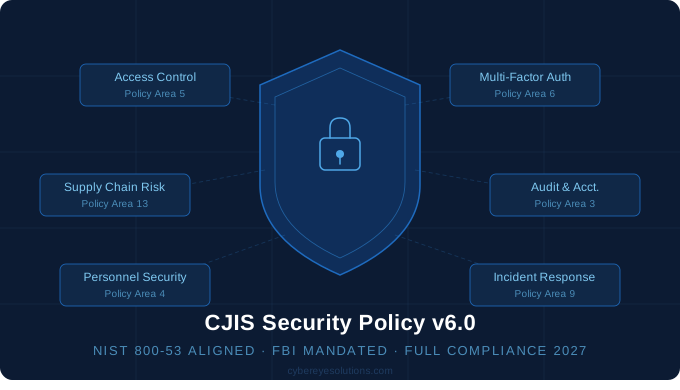
The FBI released version 5.9.5 in July 2024 and followed it with version 6.0 in December 2024. These were not minor administrative edits. Together, they represent a deliberate modernization of the policy to align with the federal government’s broader security standards — specifically NIST Special Publication 800-53 Revision 5.
The NIST 800-53 Alignment: Why It Matters
NIST SP 800-53 is the gold-standard control catalog for federal information systems. It covers more than 1,200 controls across access, monitoring, encryption, logging, incident response, personnel security, and physical safeguards. The FBI CJIS Information Security Officer (ISO) Program has published a direct mapping of CJIS Security Policy requirements to NIST SP 800-53 controls, so organizations can cross-reference compliance obligations between the two frameworks.
This alignment has two important implications. First, it brings CJIS in line with other federal mandates like FedRAMP, IRS 1075, and HIPAA — which means organizations already operating within those frameworks can leverage significant control overlap. Second, it signals that CJIS compliance is no longer a “law enforcement niche.” It is now part of the broader federal cybersecurity ecosystem.
“This was a necessary update to align with other policies from the IRS to HIPAA. It’s both vendor and tech agnostic, future-proofing workloads as we increasingly move to the cloud.” — Panelist, Mark43 CJIS Modernization Discussion, 2025
For organizations already pursuing or maintaining NIST 800-171, CMMC, or FedRAMP compliance, the path to CJIS is significantly shorter. Control reuse is a real efficiency gain.
Key v6.0 Updates by Domain
Multi-Factor Authentication (MFA) — Now Mandatory. Version 5.9.5 made MFA a hard requirement for all users accessing CJI, removing its prior status as a “recommended best practice.” This is a Priority 1 (P1) control, meaning it became immediately auditable on October 1, 2024, and sanctions can be applied for non-compliance.
Supply Chain Risk Management (SCRM) — Formalized. Version 6.0 mandates Supply Chain Risk Management Plans for all agencies handling CJI. This includes acquisition strategies for vetting vendors before onboarding, inspection of systems and components before deployment, and notification agreements requiring vendors to report breaches that affect government systems.
Security Assessment and Continuous Monitoring. Updated policies for security assessments are now codified, along with enhanced external personnel security requirements that explicitly extend to contractors. The emphasis throughout is on continuous posture management — not periodic point-in-time snapshots.
Personnel Security Enhancements. v6.0 refines sanctions guidelines to enforce greater accountability for security violations and misuse of CJI. This includes more specific guidance on background screening, access provisioning, and what constitutes a sanctionable personnel event.
Authenticator Guidance Clarified. The policy now specifies which authenticator types require annual rotation and introduces a “banned password list,” aligning with NIST 800-63B guidance on credential hygiene.
The Priority Control Framework and Full Compliance Deadline
Version 6.0 introduced a structured implementation and audit timeline using a Priority system (P1 through P4) to help agencies sequence their compliance work:
- Existing + P1 controls — Fully auditable and sanctionable as of October 1, 2024. MFA falls here.
- FBI formal auditing under v6.0 — Active as of October 1, 2025
- P2 through P4 controls — Fully auditable and sanctionable by 2027
- 2027 is the full compliance deadline — all controls across all priority levels must be implemented
Version 6.1 is already on the horizon. The next version of the CJIS Security Policy is expected in Spring 2026, with a stated cadence of updates every 6 to 12 months going forward. This is a deliberate shift to continuous improvement rather than multi-year policy cycles. Agencies and vendors need compliance programs that can absorb iterative changes — not just one-time remediation projects.
The Real-World Compliance Challenges Agencies Face
Understanding what changed is the easy part. Living with it is where agencies struggle. The compliance challenges facing law enforcement organizations today are systemic, not just technical.
Resource Constraints at Smaller Agencies
The majority of law enforcement agencies in the United States are small — fewer than 25 sworn officers, serving rural counties, small municipalities, or special jurisdictions. These agencies often have no dedicated IT staff, no full-time compliance officer, and no budget line for cybersecurity consulting. Yet they are subject to the same CJIS requirements as large metropolitan police departments.
The result: general-purpose IT staff are expected to interpret and implement detailed federal security policy with limited guidance. MFA rollouts stall. Encryption projects sit in procurement limbo. Audit preparation is reactive — agencies scramble to address findings rather than operating from a position of continuous readiness.
Fragmented and Legacy Technology Environments
Law enforcement technology is a patchwork. A typical mid-sized agency might run a CAD system from one vendor, an RMS from another, a body-worn camera platform from a third, and a mobile data terminal solution from a fourth — all integrated through a web of custom connections and aging hardware. Applying consistent CJIS controls across on-premises, cloud, and hybrid systems simultaneously is genuinely difficult, and the integration work required to achieve it can be expensive.
Legacy systems that predate modern encryption standards or lack MFA-compatible authentication modules are a particularly thorny problem. Replacing them takes time and budget that many agencies don’t have available on compliance timelines.
Audit Readiness vs. Day-to-Day Compliance
There is a meaningful difference between being audit-ready and being compliant. Many agencies focus energy on preparation when an audit is imminent — generating documentation, pulling logs, updating policies — rather than operating compliant programs continuously. This reactive posture creates two problems: it’s more expensive in the long run, and it fails to protect CJI in the periods between audits.
Continuous monitoring, regular policy reviews, and embedded training programs are the markers of a mature compliance posture. But they require investment in people, process, and tools that smaller agencies haven’t historically had access to.
Training Demands Across All Personnel
CJIS compliance isn’t just an IT problem. Officers, dispatchers, records clerks, and administrative staff who handle CJI are all subject to security awareness requirements. Keeping all personnel trained on updated policies — including the significant changes introduced in v5.9.5 and v6.0 — while competing for training time against use-of-force, de-escalation, and other mandated programs is a genuine operational challenge.
Vendor Oversight Complexity
Agencies don’t just have to manage their own compliance — they are responsible for ensuring their vendors meet the standard too. There is no “CJIS-certified” vendor designation. Hosting infrastructure in a government cloud such as AWS GovCloud or Azure Government does not automatically confer CJIS compliance. Agencies must evaluate each vendor’s identity and access management practices, encryption posture, incident response procedures, and patching cadence independently.
The Commercial Opportunity: CJIS Compliance as a Market Differentiator
For companies selling technology or services into the law enforcement and criminal justice market, CJIS compliance is not a nice-to-have. It is increasingly a procurement requirement, and agencies are getting better at asking the right questions.
A vendor that can demonstrate a mature CJIS compliance posture — documented supply chain risk management, NIST 800-53 control alignment, signed Security Addendum capability, and clear incident response protocols — is a vendor that shortens an agency’s procurement due diligence cycle. That is a concrete commercial advantage.
The opportunity is even clearer for vendors pursuing state and local government contracts in adjacent markets. Agencies subject to CJIS are often also subject to other frameworks — HIPAA for jail medical data, IRS 1075 for tax offset programs, and NIST CSF for broader IT governance. A vendor that has done the work to align with CJIS and NIST 800-53 enters these conversations from a position of credibility.
The question to ask your sales team: when a law enforcement agency asks “are you CJIS compliant?”, do you have a documented, defensible answer? If the response is “we follow best practices” or “we’re hosted in the cloud,” you are losing deals to competitors who can speak to their compliance posture with specificity.
How CyberEye Solutions Can Help
CyberEye Solutions works with agencies and commercial organizations on both sides of this equation. Our team understands CJIS not as an abstract regulatory framework but as a practical compliance challenge that organizations have to live and operate within every day. That distinction matters in how we deliver engagements.
CyberEye CJIS Compliance Workshop
We offer a structured, flat-fee CJIS Readiness Workshop designed to give your organization a clear picture of where you stand and what needs to happen next — without the ambiguity of a multi-month assessment engagement.
Our workshop is built for two audiences:
- Agencies subject to CJIS — law enforcement, courts, prosecutors, and noncriminal justice agencies receiving CJI — who need to understand their gap posture, prioritize P1 controls, and build a realistic compliance roadmap toward the 2027 full compliance deadline.
- Commercial vendors and technology providers selling to the law enforcement market who need to document their CJIS compliance posture, understand Security Addendum requirements, and position their security program as a competitive differentiator in government procurement.
What the workshop covers:
- CJI scoping and data flow mapping — where does CJI live in your environment, and how does it move?
- Gap analysis against v6.0 policy areas and NIST 800-53 control families
- Priority control identification and 2027 compliance sequencing (P1 through P4)
- Policy and procedure review against current CJIS requirements
- Vendor and third-party obligation review (Security Addendum, SCRM)
- Prioritized remediation roadmap with realistic timelines toward the 2027 deadline
- Audit readiness briefing for agency leadership
Engagements are scoped to your organization’s size and complexity. We work with small rural agencies and enterprise technology vendors alike.
Beyond the Workshop: Ongoing CJIS Program Support
For organizations that need more than a one-time scoping exercise, CyberEye offers ongoing vCISO and GRC advisory support that integrates CJIS compliance into a broader security program. This includes:
- Policy development and maintenance aligned to v6.0 and updated versions as they release
- Continuous monitoring program design and oversight
- Vendor risk management support for agencies managing a complex technology ecosystem
- Audit preparation and post-audit corrective action plan (CAP) support
- Security awareness training coordination for CJIS-covered personnel
- Cross-framework mapping for organizations also subject to CMMC, HIPAA, NIST CSF, or ISO 27001
CJIS is a long-term compliance obligation, not a one-time project. As the FBI moves toward 6-to-12-month policy update cycles, the organizations that maintain structured programs will outperform those that treat compliance as episodic. We help you build the former.
The Bottom Line
CJIS Security Policy v6.0 is not a distant deadline. Auditing is active. Priority 1 controls — including MFA — have been sanctionable since October 2024. Full compliance across all P2–P4 controls is required by 2027. The policy’s alignment to NIST 800-53 raises the sophistication bar, but it also creates real opportunities for organizations already working within federal frameworks to consolidate and streamline their compliance posture efficiently.
For agencies: the organizations that get ahead of this will spend less time in reactive remediation and more time focused on the mission. For vendors: being able to speak credibly to your CJIS posture is no longer optional in this market.
If you’d like to talk through where your organization stands, reach out to CyberEye for a no-cost initial conversation.
CJIS Links & More Information
- FBI CJIS Division — CJIS Security Policy v6.0 (December 27, 2024). le.fbi.gov
- FBI CJIS Division — Requirements Companion Document to FBI CJIS Security Policy v6.0. Available via FBI Law Enforcement Enterprise Portal (LEEP).
- FBI CJIS ISO Program — Security Control Mapping of CJIS Security Policy Requirements to NIST SP 800-53 Rev. 5. fbi.gov
- IACP CJIS Security Modernization Working Group — “CJIS Security Policy Modernization: What Police Leaders Should Know.” Police Chief Online, April 23, 2025. policechiefmagazine.org
- IJIS Institute — “NIST Policy Templates: A Resource for CJIS Security Policy Compliance and Modernization.” December 2025. ijis.org
- Info-Tech Research Group — Build a CJIS Compliance Program blueprint. October 2025. infotech.com
- Mark43 — “Modernizing CJIS Compliance: Key Takeaways for Public Safety Agencies and IT Leaders.” August 2025. mark43.com
- Imprivata — “CJIS 6.0 Compliance: Key Changes, Why They Matter, and How to Prepare.” imprivata.com
- Microsoft Azure — Criminal Justice Information Services (CJIS) Compliance Offering. learn.microsoft.com
- California DOJ Information Security Office — 2025-ISRS-001: CJIS Security Policy v6.0 Notice. oag.ca.gov